
Building the Future with Community Robotics with Dillan Sayers
TechXY Turbo, Episode 10
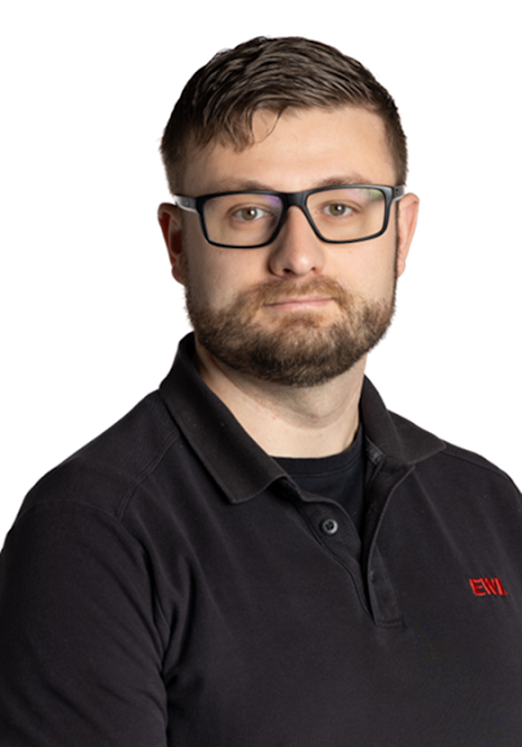
Dillan Sayers is a Buffalo-based automation engineer and long-time robotics mentor committed to expanding access to hands-on STEM education. At EWI’s Buffalo Manufacturing Works, he designs and integrates advanced automation systems, custom robotics solutions, and smart manufacturing technologies. His work draws on skills he began developing in high school through FIRST Robotics, where he first saw how transformative STEM experiences could be for young people.
For more than a decade, he has mentored robotics students across Western New York, helping them build technical abilities, confidence, and direction. This passion led him to found Rust Belt Robotics, Buffalo’s first free, community-based FRC program. What began with a few students in his garage has grown into a multi-school initiative serving youth from over 20 schools.
Sayers is driven to provide real tools, real engineering, and real mentorship to diverse learners, using robotics as a platform to create opportunity and impact in Buffalo.
Listen to “Building the Future with Community Robotics” below, or on Apple Podcasts, Spotify, YouTube, Amazon, Pandora, or wherever you get your podcasts. The episode transcript is shared below the embed.
TechXY Turbo - Podcast Transcript - (E10)
Frank: Welcome to another episode of TechXY Turbo. My name is Frank Gullo and I am your host.
On this episode of TechXY Turbo, we’re joined by Dillan Sayers, a Buffalo-based automation engineer and long-time robotics mentor committed to expanding access to hands-on STEM education. At EWI’s Buffalo Manufacturing Works, Dillan designs and integrates advanced automation systems, custom robotics solutions, and smart manufacturing technologies. His work draws on skills he began developing in high school through FIRST Robotics, where he first saw how transformative STEM experiences could be for young people.
For more than a decade, he has mentored robotics students across Western New York, helping them build technical abilities, confidence, and direction. This passion led him to found Rust Belt Robotics, Buffalo’s first free, community-based FRC program. What began with a few students in his garage has grown into a multi-school initiative serving youth from over 20 schools.
Dillan, so great to have you on TechXY Turbo. How are you doing today?
Dillan: Good, Frank. How are you?
Frank: I’m doing great. As you know, this is a tech podcast featuring people with varied backgrounds in tech. So let’s start with your story. You’ve got a very interesting background with mechanical aerospace engineering from UB, experience with advanced manufacturing with battery technology and now automation engineering at EWI. How did you first get into robotics technology? What was the year and what sparked your interest?
Dillan: Really it was joining a team similar to mine back in high school in Rochester, NY. I grew up in Churchville / Chili. I was lucky enough that our school had a high school FIRST Robotics team, Team 340 Greater Rochester Robotics. I’ll give them a little bit of credit here.
One of my longtime friends I’ve known since kindergarten decided to drag me to a robotics meeting. I started a little late compared to some—I think it was my sophomore year of high school. He dragged me into the robot lab, and I never left kind of thing. There are a lot of stories related to that, when you get dragged into the robot lab one time and you’re kind of hooked. That was my start to robotics. That evolved into—I always knew I was going to be an engineer—and that helped make me a better engineer and then pushed me down that road.
Frank: Elaborate on that. You were a participant on a FIRST Robotics team in high school, and then you mentored at the Nichols School for nearly eight years before founding Rust Belt Robotics. For listeners who aren’t familiar with these terms, can you first explain what is a FIRST Robotics competition and more so what technology challenges are you solving in these competitions?
Dillan: I’ll start with FIRST Robotics. FIRST Robotics is a large educational nonprofit. It’s really international at this point. There are teams from all around the world we compete with, which is one of the really cool things about it.
There are various levels. There’s FIRST Lego League, so much younger students can compete. Our team is in Rochester; Buffalo doesn’t have one yet. There’s FIRST Tech Challenge, which is kind of that middle school to high school and slightly more budget-friendly, kind of 18-inch by 18-inch sized robot competition.
Then there’s FIRST Robotics Competition, FRC, all within the FIRST umbrella that is a much bigger robot, almost a 150-pound robot when you’re all said and done, competing on a 50-foot by 25-foot competition field, almost the size of a basketball court.
Every year for the FRC—we can focus on that—we get a new challenge. This is similar to FTC and FLL. But for FRC it’s slightly more abbreviated, your build time. You get a new challenge in January, so our exciting time of the year is coming up.
Anybody listening: you want to have your student join now. Now is the time. Exactly a month from tomorrow (1/3/2026), we get our new challenge. We’ll have then—it used to be about six weeks when I was in high school. Some of the rules have changed where it’s around 12 weeks now to build a whole competition robot to complete a new challenge.
It’s kind of like three-on-three sports, if you will, where three robots competing against three robots. Only one of them is yours necessarily. The challenge could be throwing frisbees, scoring dodgeballs, shooting things, stacking things. We have stacked trash cans. We’ve thrown exercise balls. If you can name it, they’ve come up with it in the past. So it’s a new challenge, and that’s the fun part. Everybody is designing a new thing all around the world. Then you get through about 12 weeks and you show up and you get to see what everybody has.
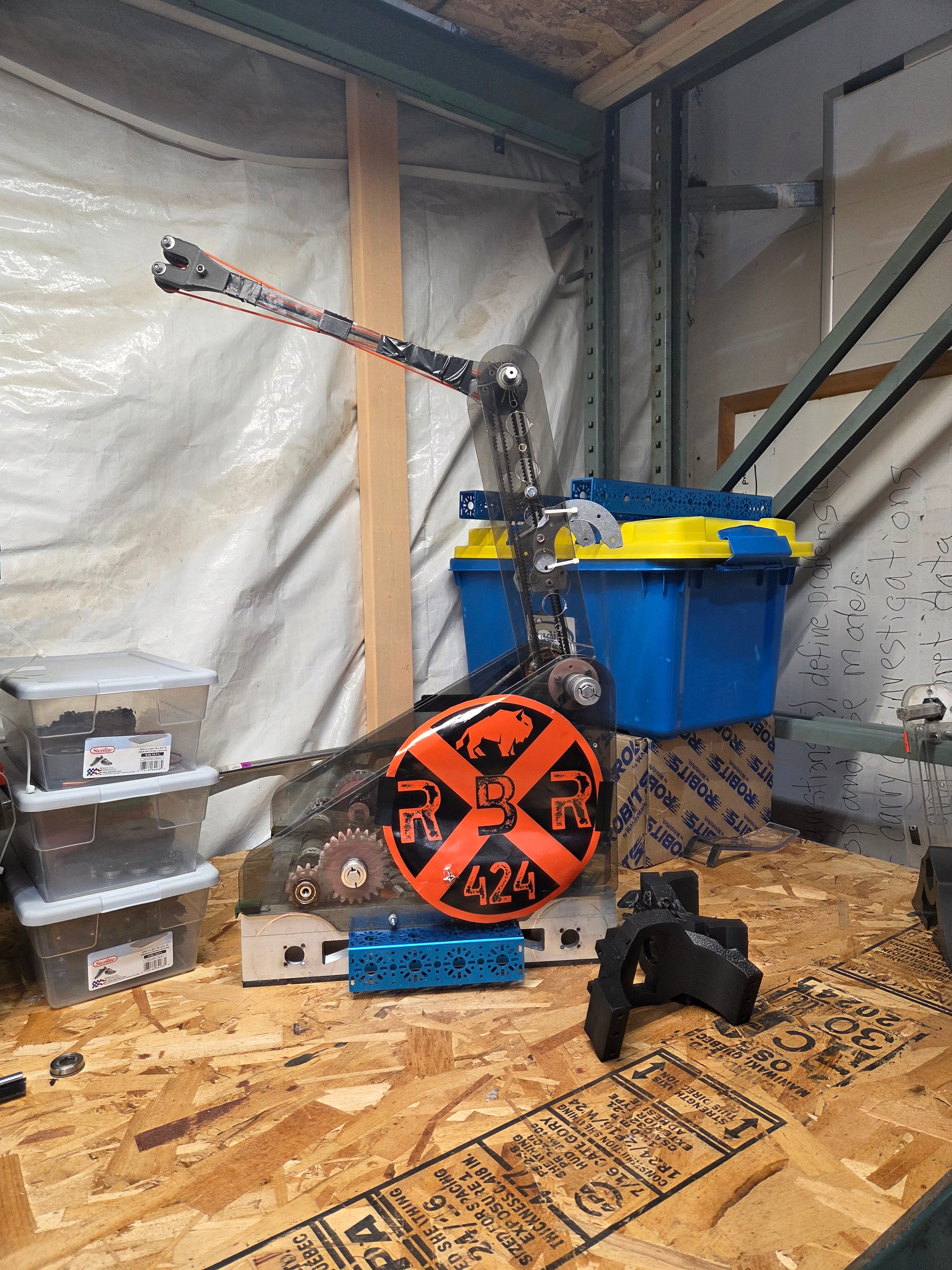
Frank: That sounds very cool. Three months to build a robot. Before we decided to to do this, I stopped by the lab, and have some photos for the transcript. Very cool stuff.
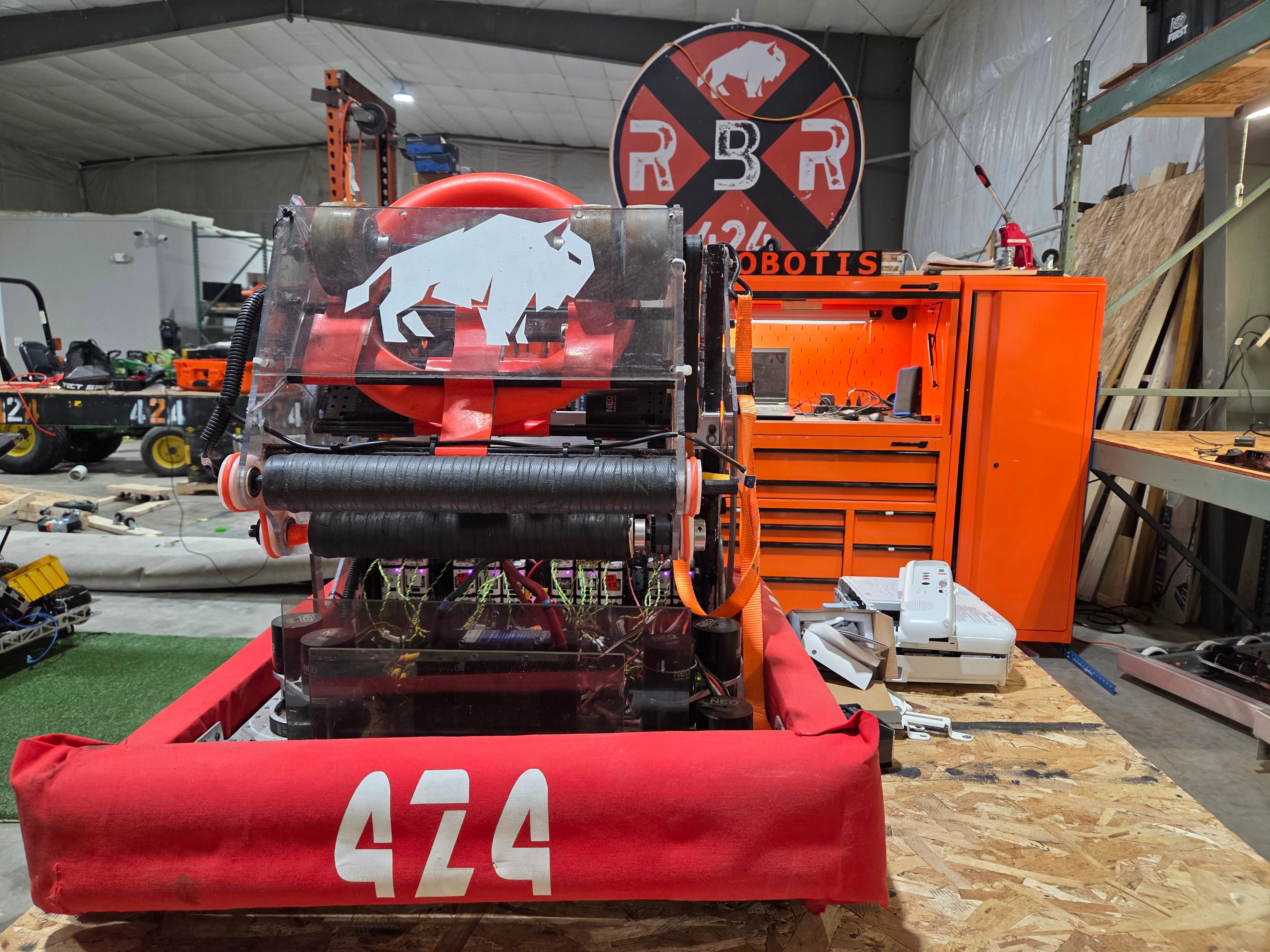
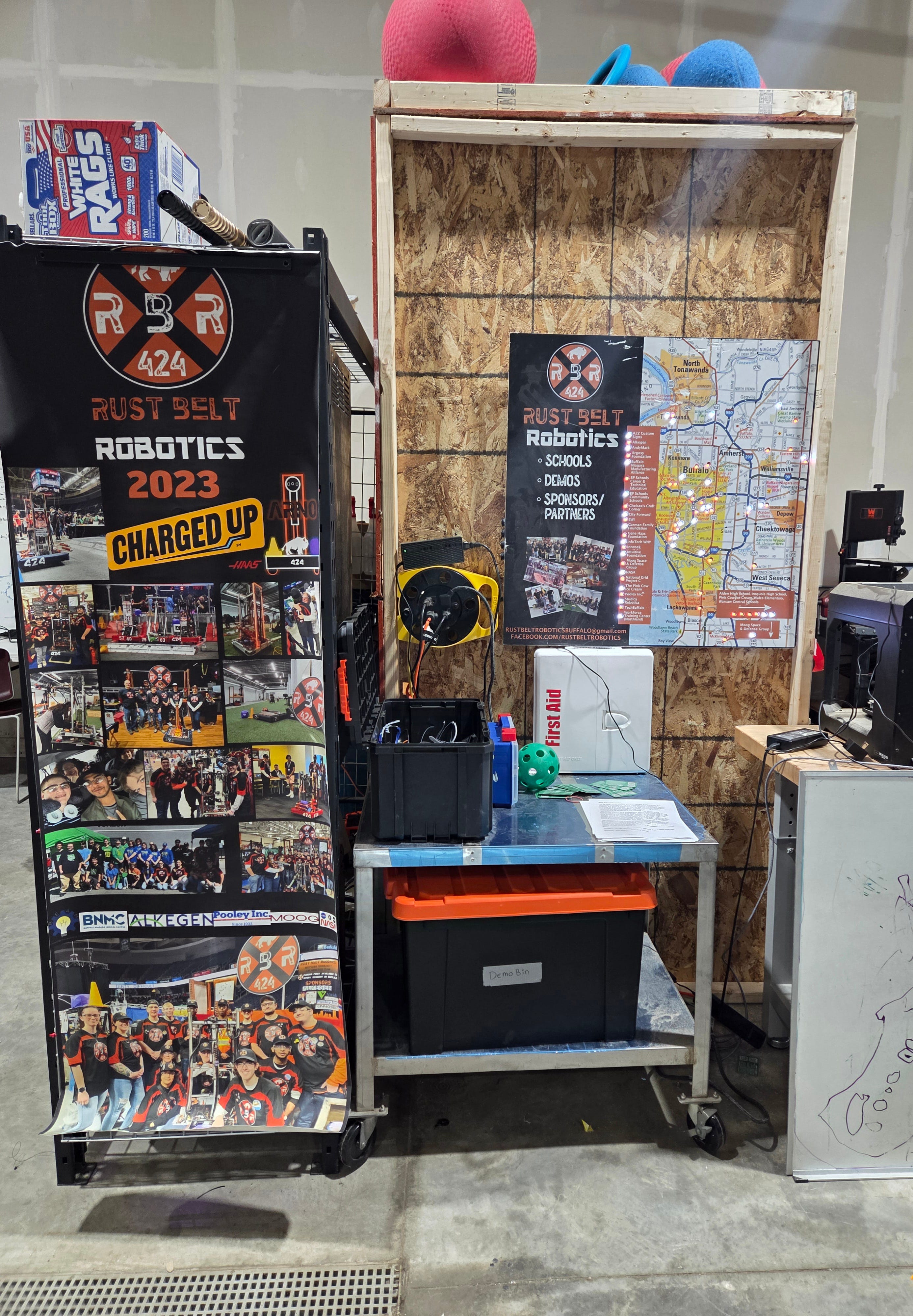
Frank: You spent almost eight years mentoring at the Nichols School before founding Rust Belt Robotics in 2022. What made you decide Buffalo needed a community team? What gaps were you seeing that school-based teams couldn’t on their own fill?
Dillan: I’ll go back to a bit of my story from Rochester. I grew up in Rochester in the late ‘90s, early 2000s. Rochester was a really, really good city to be in and that benefited the robot teams a lot. Rochester has about 20 different schools and robot teams in those schools. So there’s 20 teams.
I went to UB for engineering, came to Buffalo and realized that there was really only one team in Buffalo. So we started another team. But both of those teams ended up at private schools. Nichols is a private school in Buffalo, and I think it’s safe to say the cost is at least $25,000 a year to attend Nichols as a student.
As I mentored there, it was kind of informal, but outside students were allowed to be on the Nichols robotics team. As we got more competitive through the years, I think some of the higher-ups at Nichols, maybe not necessarily the teachers or the mentors there, wanted close that off a little bit more and make it so it’s something you have to attend Nichols to come do.
I donated my time for all those years helping students and all that. And I said, well, I think it should be free if you’re getting all this donated time. And that’s really how FIRST Robotics teams works: you have all these engineering mentors and people that donate their time to teach the students, and not just your average teacher can teach this sort of stuff.
There are some really good and excellent ones out there that can do that, but they need help. There’s not a single teacher on their own on an FRC team anywhere in the world. I think it’s safe to say they have a lot of help.
So I saw that need. There were only two teams in the community. Everybody couldn’t join easily. So I thought, let’s figure out how to make it free and make a community team that can service effectively all of Buffalo.
I have a greater goal to start more teams in schools eventually. But right now we have students on our team from over 20 different schools, from Buffalo in the surrounding communities. 20-plus schools all coming to work on one robot.
Students coming all the way from Warsaw. At times we have a student that comes in from France and joins our team and then goes home. A few students have immigrated to Buffalo from like places like Bangladesh and from around the world. That’s pretty cool.
Frank: That’s great - thank you for sharing the backstory as all parents are concerned about cost activities for their kids, and I want to highlight that a little more. Rust Belt Robotics is free for all students to join and accepts students from any school and any background. That’s a significant commitment as robotics programs can be expensive. How do you make that work? What does it take to run a technology program that’s truly accessible to everyone?
Dillan: Making it work, it’s been a lot of fun, and I’ve learned a lot. I came as an engineer and now I feel that I do more other stuff than engineering, as I’m sure most company and nonprofit founders do. Every year we write grants to try to make it free for our students who attend.
We try to have students and parents participate and help as much as they can. So, like when we travel, if parents can come with their students, that’s great. If not, we try to try to support them as much as we can to get the competitions.
We ask companies in Buffalo to sponsor the team, and that’s a big part of what we do. I think those companies are finding they want my students because frankly they’re the best in Buffalo. A few of them have gotten some pretty high end internships, a few graduated and are going to colleges in Buffalo, a lot of them, most of them, for technology degrees, neuroscience degrees, engineering degrees.
So that’s pretty neat in general. As far as trying to make that happen and keeping it free, it’s a pretty big obligation and it’s been tough. I’m learning how to make that happen as we go. I like saying I like going from good problem to good problem.
So needing more money is a good problem because it means I have more students and more students to support. And it means we’re growing. So every good problem is a good thing, I suppose.
Frank: Thanks for that. On the skill side, we touched on your work in automation and advanced manufacturing at EWI, and before that you worked on battery technology and specialized processing equipment. When you’re teaching students electrical, programming, and mechanical design through robotics, how directly does that connect to real engineering careers? Are you building Buffalo’s future workforce? It seems like you alluded to that with the last answer.
Dillan: I would say very much so. The robots we build, to try to give everybody a picture, are very mechanical in nature. So you’re not just picturing a robot arm, which we do get students opportunities to play with and learn on. At EWI last summer, we did a summer camp with with some on site.
But more so the robot I always view as a vessel for learning. Our robots are designed and built from scratch, and that’s the vessel for learning. And all the things that involve around it, all the engineering disciplines, past robotics, that relate to professions and roles I’ve had in the past.
Our students learn to machine and CAD model our robot parts. That directly goes into it. I use CAD almost every single day for the last 15 or so years of as a professional engineer and in engineering school. It’s almost an essential thing. It’s almost like breathing, CAD modeling is for a mechanical engineer.
We’re all the engineers, not necessarily computer engineers but you need to be able to read everything. I have to dabble in programing here and there, despite having just a mechanical engineering degree.
If you’re touching engineering, you kind of have to know all the disciplines. So it’s extremely relatable because some of the stuff I do at work are the same things I’m doing at the robotics lab. Some days I’m 3D printing something for for work, a new robot gripper, a new new end effector or something like that.
Then I go to robotics and teach the kids how to how to 3D print a gear or something for a new robot. Or this year, we’re actually doing this for our FTC team, we’re 3D printing a whole robot frame, trying to 3D print the whole robot kind for a fun limiting activity. So it’s very relatable and straightforward how this integrates into real world engineering, which is pretty excellent.
Frank: Fascinating. And reminds me of past work years alongside engineers. Walk us through what it actually takes to build a competition robot. What technologies are students learning - programming languages, control systems, mechanical design tools? And how complex do these robots get? What can they do?
Dillan: First, especially, FRC has become a bit of an arms race. I don’t know, I guess it’s always been that way, but especially of late. There is some standardization that happens, but then something comes out just like in the real world, like AI over the last few years, and stirs the whole pot.
So that’s been fun. But as far as programing languages, our robots can be programmed with C++, Java or LabVIEW, which are all relatively relevant. We also have onboard computing on the robot where we can add. So we can add Arduino as we can add Raspberry Pis, we can add Orange Pi, all those fun little microprocessors in those program and similar things, but also Python and all those other relevant programing languages.
There isn’t isn’t much in the way of very current era relevant programing languages that we don’t have the opportunity to touch in the lab. We also learn: we have a few CNC routers in our lab, one of which the students rebuilt and we tied it into a new controller.
So they learned Mark III, which is a pretty relevant CNC control and integration system. We post G-code. We use CAD cam to post our G-code of our robots. To our CNC machines, we cut them out. So just like your average manufacturing environment.
For anybody using Mastercam, our students have that opportunity. We’re using CAD software, and right now I have students using anything from Onshape to Autodesk Inventor to SolidWorks. And then a few people are using FreeCAD. So we have probably like four different CAD software our robots are getting modeled in here and there.
I kind of let the kids pick. As far as standardization, I try to avoid that. And and now lately I feel more and more pushed to use stuff that the kids talk about. So I don’t want to be that that old guy or that old curmudgeon that’s using. I won’t name a given software so they don’t come help me down.
But especially, a lot of my students come in saying, “Hey, Onshape is real easy. Dylan, why aren’t you using this?” And I’m, well, last year I was resisting. This year, I’m starting to crack and opened it up and started playing around with it.
I’m still not as good at it but for standardization, our kids do push a lot of the technology and it evolves quite a bit just like industry. I think in some cases first robotics is where some of the interesting stuff is, the smartest kids are doing first robotics from around the world.
Then they’ll graduate, they’ll go to engineering school, and then they’ll get into the industry and they’ll say, I want to use this tool because I’m good at it. That’s why I think for things like Onshape (as CAD software), I should probably learn.
Frank: A bit of a follow up. To date myself a little bit, when I was in middle school, we had shop class, and I specifically remember our metalworking and wood classes as probably my favorite classes that year. Have you made learning fun for students? Do they they realizing what they’re learning?
Dillan: I like to say that our environment is really fun. I have a lot of kids. On occasion they saying, “Hey, Dylan, I need something to do”, which is good. They’re not sitting around and not doing anything. Asking for something to do is another one of those good problems.
I guess as they go, I think they realize what they’re learning. But I don’t think they value it quite as much. I have some students that started and one day I realized a small group of my students didn’t even know what a Phillips head screwdriver was, even though they probably can program in JavaScript.
So it was like, all right, let’s let’s find an old kit robot that we accidentally purchased at one point. We didn’t opt out of and had a kit of parts. So I go, all right, let’s put this robot together. It comes with instructions. And so they’re learning how wrenches work, what are open end wrenches, and they definitely would have went looking for the left handed crescent wrench if I asked them to (and some of them do).
It’s that fun learning environment. We have some mentors that are super enthusiastic. We have one new mentor, and the guy has, it feels like 40 3D printers in his garage at home. He 3D prints Iron Man outfits and wears them to robot meetings, getting the kids excited about engineering which is a big part of it.
I think the learning that they do, I think sometimes they don’t even realize all of what they’re learning because they’re just in this environment, the labs kind of makerspace, and they don’t really fully realize the things they’re adjacent to that they’re learning as they go through a robot meeting.
Frank: The name ‘Rust Belt Robotics’ seems intentional, that you’re embracing Buffalo’s industrial heritage. How does that history inform what you’re building? Why is Buffalo, with its manufacturing legacy, a great place for a robotics and STEM education renaissance?
Dillan: Going back to the Rochester Buffalo comparison, I really think now is the time for Buffalo, and that resurgence is either starting to happen or already is happening. I like going to the roots. Buffalo has a lot of beauty in old buildings and a lot of industrial manufacturing used to happen here. And I think a lot of it still does. There’s some amazing stuff that happens in Buffalo. I get the opportunity at work. We run a program where we help small, medium sized manufacturers integrate new robotics and technologies, and the types of companies I get to go into in Buffalo and see is just incredible.
And they’re just kind of sitting here and making stuff, plugging away. They need people and students that are excited about engineering. UB is a great example of their engineering program doing excellent work, graduating a lot of engineers. But we have to keep them in Buffalo and keep growing Buffalo.
So tying all of that rust best robotics name into into Buffalo. A lot of people sometimes think Buffalo is a little bit on the fringe of the rust belt, but they truly are a part of it. So trying to embrace that mentality. And for our team is, we go to competitions, we’re scrappy and we have that Buffalo personality.
I think everybody agrees with that personality, that Buffalo has a rust belt personality that’s been there, and there’s also a new one, upcoming and steamrolling through the new things. That’s why we, we kind of took that name and decided to use it and, and go with it.
Frank: I think it works. There’s also a fair amount of advanced manufacturing here as well, there’s a lot of engineers, there’s aircraft, industrial, to name a few. So you’re tying into both the old and the present, like like an up and coming team.
You’ve been running Rust Belt Robotics for over three years now. What changes have you seen in the students who participate? And beyond the individual students, how is this affecting Buffalo’s broader tech and engineering community?
Dillan: Last year was a bittersweet year for me. We had our our first student who had been with the program for its whole entire life graduate and go to college last year. So I won’t get another one of those because now the history is one year shorter. He’s at UB for mechanical engineering and aerospace, and I like using this student as an example. He was a recent immigrant from Bangladesh, joined our robotics team pretty recently after immigrating, went to a Buffalo city school.
he trained with our team and had a lot of social anxiety. Didn’t like big rooms with big environments and all that sort of stuff. Which I don’t blame him. He had a lot of new stuff going on, including a new language, a new country and a new state and a new home.
But as he developed through three years, he ended up bringing more students to our robotics lab than anybody else. I don’t know what his career trajectory was as a sophomore or freshman in high school when we met him. But he graduated and now he’s going to UB for mechanical and aerospace engineering.
We still see him at the robot lab here and there. Our students change a lot. It’s hard to say what credit I or the mentors should take for that; it’s really all them doing it. I just put them in the space, and certainly they learn a lot from every everybody else they’re around and not just at the robotics lab. It’s kind of incredible to see some of our students, sometimes they’ll come in and they’ll all of a sudden be 12 inches taller.
It’s also pretty incredible to see as we go what they learn, what they’re capable of. All of a sudden some student will come in and they’ll decide, all right, I’m going to be locked in and I’m going to start really doing this particular part of robotics right after a year of kind of dabbling around and goofing around and being the kid isn’t always focused.
Then all of a sudden I have a programmer or a kid who wants to run the CNC machine all day, or a 3D printer or something like that, that they really want to focus in on and do. So that’s that’s pretty incredible.
To the second part of your question, as we grow and develop and provide Buffalo with that next generation of of engineers and innovators, I think this will help help grow Buffalo, feed us into more advanced manufacturing, more robotics.
Obviously, robots are coming, AI is coming, and it’s changing the world, slowly but also quickly in some instances too. So I think this helps prepare those students and our city for all that change too.
Frank: Definitely. For those out of the area, Dylan and I are talking about Buffalo and Rochester, and they’re about an hour away and I kind of see the ecosystems blending together.
Before we came in, I was on LinkedIn, and one of the things I saw and wanted to ask you about since you work with real robots, and you actually build robots.
I see a lot of the imagery of robots either as like kind of a robot servant, like Optimus or the Terminator. How do you feel about how robots and AI are being portrayed? Do you feel this is mainly fear mongering or marketing? Like as someone who works with them and sees the real potential, how do you what’s your take on the current climate of how robots are portrayed?
Dillan: If you’re looking at your your everyday TikTok or Instagram portrayal of robots and and all that. I’m not that’s all that accurate. I don’t think necessarily AI is coming to get us. I think there’s some things we should probably be watching out for, but I think it’ll generally be a big help.
There’s some things that I’m really excited and waiting for someone to develop, to help my everyday running a robot team and having a day job and all that stuff. There’s some things that AI could help me do every day that would make some things easier. So I have more time to to spend places that I enjoy.
Looking at manufacturing facilities and what robotics can do there, in a lot of cases you have people that are saying these are taking jobs and that sort of thing. In a lot of cases, we’re putting robots in places where they can’t fill a job because it’s either a mundane task that someone doesn’t want to do and one with a lot of turnover. Or it’s a task in which someone’s getting injured or something that you need a robot. In a lot of cases, there’s this skill gap or if you can relieve somebody from doing something that’s very repetitive, they can then go learn something and make the company even better.
I think that’s a lot of what we do with robotics. I don’t I don’t buy much into the robots are taking our jobs thing because a lot of cases they can’t fill the jobs anyway. And for things like Optimus, those are longer outsets. Those robots are are definitely coming.
There are a lot of cases with the robot arms and industrial settings are the more practical things to be talking and learning about and looking at right now. Those are the ones that are most greatly impacting people’s lives, whether they see it or not.
That’s what’s I know. Prices and costs are pretty high, but they’re they’re not astronomical. In a lot of cases, it’s because robots are manufacturing things that in the past were all done by hand. And that’s freeing people up to do the things they are more passionate about.
Frank: Right, good point, thank you. Speaking of AI and robots helping, I asked an AI assistant to analyze your background and generate a closing question. Let’s see what it came up with.
‘Dillan, you’ve combined your professional engineering expertise with a passion for education to create something that didn’t exist before—Buffalo’s first community robotics team. As you look at the next generation of students going through Rust Belt Robotics, what emerging technologies or engineering fields are you most excited to expose them to? And what does success look like five or ten years from now—both for the students and for Buffalo?’
Dillan: I’d like to try to figure out more and more how we can integrate AI into the building of our robot. I think that’s obviously a new field, and I think there are a lot of cool applications of AI, even with the capability level that’s out already that can be leveraged.
I think the younger generation are the ones that will have the cool ideas on how to leverage that. Just like how 3D printing is going through a revolution right now where people thought maybe five years ago, this is as good as it can get, and now in the last five years it’s just blown up. I saw somebody selling soap filament the other day.
Who would have thought you wanted a 3D printer with soap? But now you can. That’s the type of stuff that gets our students into AI, figuring out how it can help them develop and engineer things. I view it as a tool, like a calculator. They should learn it and use it because it’s a tool they have in their in their engineering portfolio.
Really, all engineers do is learn how to solve problems better than everybody else. Knowing what tools you have to solve those problems is half of the battle. If you don’t know a tool exists, you can’t use it. And if you don’t know how to use a tool, and especially if you can’t use it and can’t leverage it.
For outset, Rust Belt Robotics has been growing significantly. I started three years ago in my garage with three students. And, now have 30 to 40 students in total on the team, which is another one of those good problems to have as we grow.
I’d like to view this a little less as a robotics team and more as an opportunity to do a little bit more for Buffalo. That we’re developing a great makerspace with a lot of tools. And how we can leverage and help people other than just students.
As we grow, I want to expand the types of students we can reach. Maybe younger, maybe a few older as well. Everybody’s a student in our lab, including myself. So we have a few young UB engineers that have been mentoring our team. And we’ve been helping.
They’re a new company, a new educational company, and they might be a neat one to have on the podcast at some point. They’re developing boards that you can use to build your own robot and design your own robot. Right here in Buffalo, which is pretty neat, and we’ve been helping them here and there with some of our tools and 3D printers as they’ve been developing products.
Rust Belt Robotics maybe growing into more of that stuff and supporting our mentors and all of that would be pretty neat. Also expanding the teams in Buffalo - I didn’t start Rust Belt Robotics to be the only community team that wasn’t in a private school in Buffalo.
I’m hoping we can expand to include other teams, whether they’re in schools or another community team or even more robotics teams within our our building would be great. Acquiring more mentors, more students, and then more support. Getting support from manufacturers in Buffalo to help either volunteer and mentor the team, or donate to the team, or even provide tours. We like getting our students tours at different manufacturing sites around Buffalo, which is another fun thing.
Frank: I’m excited to get this out to my network. Which brings us to the close. Dillan, it’s been really great having you on TechXY Turbo, learning your story. To close, where can listeners connect with you, learn more about you and Rust Belt Robotics, and also for parents, and you mentioned the competition in one month. Any specific dates they should keep in mind this holiday season?
Dillan: We’re very accessible. If you Google search “robotics and Buffalo,” we’re like the third result down after after UB and you can search “Rust Belt Robotics”. We have a website. Our email is rustbeltroboticsbuffalo@gmail.com. We’re on Facebook and Instagram, you can message us there as well.
Our current lab is up in Getzsville, NY, right by the University of Buffalo. So any UB students or mentors that want to come help mentor. For ages, FRC is supposed to be a high school focused, oriented program, but we also have students as young as eight years old on the team.
But I like saying those younger students are very focused, dedicated students that we’ve acquired. I like letting those younger students come for a meeting and feel it out and see what they think. We’ve also been looking at starting an FLL team as well, at some point in the future. So if you have younger students, I’d like to know of parents that are interested in students that want to be on a team.
Those are those are the main ways to contact and get a hold of us. As far as dates, January 3rd is kickoff day. That’s when our FRC team gets our brand new interesting fun challenge.
I like saying it’s the biggest day of the year, because competition is a little too stressful to be the biggest, fun day of the year. So we get the new competition where we’re feeling out the game where we do some test games and where we like play the game out as humans to see what type of scores we can get and what types of strategies.
Then we start talking about robot design, even though we should be talking about just general strategy. And that really kicks off the next 12 weeks of intense fun and learning. So if you can join then, it’s not too late after that point, but I would say reach out and try to try to have your student at kickoff day if possible, because that’s really the most fun, most exciting day of the year. And nobody feels left behind at that point because everyone gets the same challenge on the same day.
Frank: Really good. Dillan, it’s been great to have you. Thanks, looking forward to hearing what you do next.
Dillan: Yeah. Thanks, Frank.

Love the emphasis on accessibility here. Making FIRST Robotics free and cross-school is huge becuase the skill gap in industrial automation actually starts way earlier than most ppl realize. The comment about students not knowing what a Phillips head screwdriver was but being able to code in JavaScript is telling—there's this wierd bifurcation where digital skills outpace hands-on mechanical intuition. I've seen factories struggle to hire CNC operators precisely because candidates lack that tactile foundation even when they have programming chops. Programs like this close that gap early.