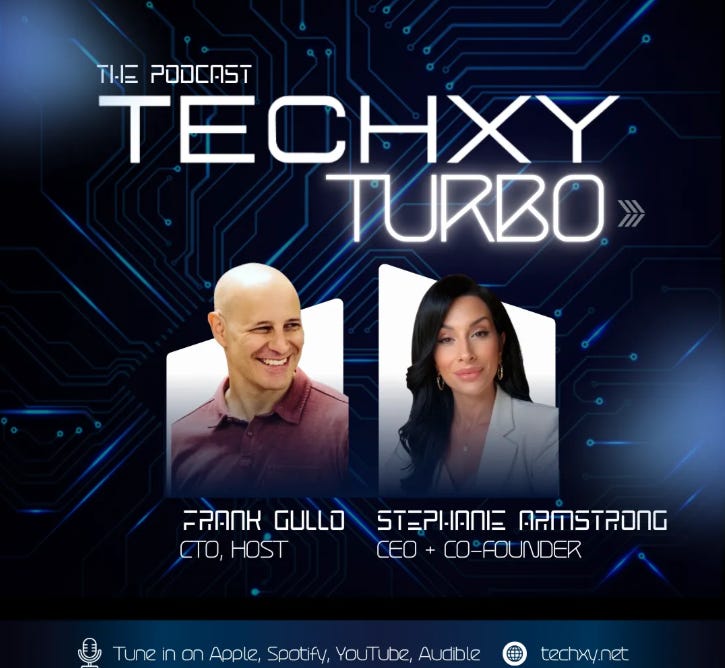
TechXY Turbo - Episode 3
Brand Power & Tech in Marketing with Stephanie Armstrong
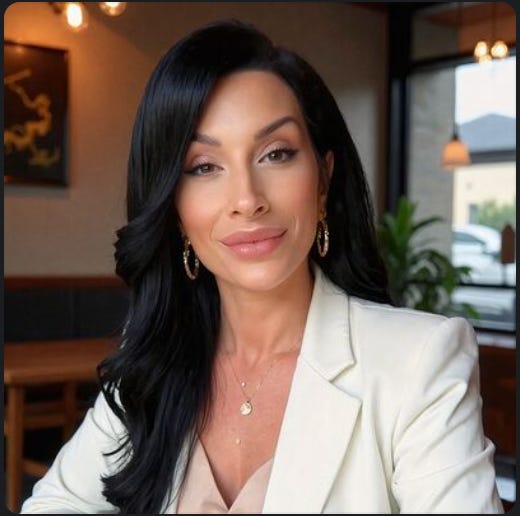
Stephanie Armstrong is a visionary architect of brands and businesses. With a Midas touch for transforming brands, she has orchestrated groundbreaking partnerships with global titans like Pepsi, Universal Studios, and Louis Vuitton Moët Hennessy. She is the Co-Founder of Moxie Creative Studios, leveraging her strategic marketing acumen to propel businesses worldwide, generating over $40 million in growth.
A passionate advocate for diversity and innovation, Stephanie is a driving force in the marketing industry and a catalyst for change in her community. As the architect of Upstate New York's Minority & Women Owned Business Summit, she fosters a thriving ecosystem of empowerment and opportunity. Her commitment to uplifting others is evident in her leadership roles across various organizations, including Rochester Global Connections, Champion Academy, Miss Julie’s School of Beauty, and the New York New Jersey Minority Supplier Development Council.
On this episode of TechXY Turbo, Stephanie shares how she blends brand strategy, tech tools, and storytelling to scale creative businesses and build lasting impact.
Please enjoy and listen to the episode on Apple Podcasts, Spotify, YouTube, Amazon, Pandora, Podcast Addict, Deezer, JioSaavn, or below.
Transcript
Frank Gullo: Welcome to another episode of TechXY Turbo. My name is Frank Gullo and I am your host. Today we are joined by Stephanie Armstrong, the co-founder of Moxie Creative Studios and a powerhouse brand strategist. Stephanie has led major campaigns and partnerships with brands like Pepsi, Universal Studios and Louis Vuitton. Generating over 40 million in growth, Stephanie is also a champion for equity and entrepreneurship. She leads Upstate New York's Minority and Women Owned Business Summit and supports rising founders through mentorship and impact focused initiatives.
Stephanie, great to have you here today. Can you tell us a little bit about yourself and the work you're doing today?
Stephanie Armstrong: Yeah, absolutely. So, as you mentioned, I'm the co-founder and CEO of Moxie Creative Studios. Our specialties are in branding, omnichannel digital marketing and events. However, you know, with the way that things work today in terms of everything kind of being much more interconnected, our hands end up in a lot of different buckets when we're working with businesses. So we've had the opportunity to scale and support the scale of many different companies through that process.
We really focus today on impact driven work. So just people and businesses and organizations that are trying to do something positive, make some kind of impact. We've supported businesses of both kinds. But, you know, when we really got conscious and intentional about how we wanted to use our gift and our skill set, we really wanted to focus on using that to amplify voices that the world needs to hear right now.
We also have a specialty and personal branding, where we're really working with those impacts driven leaders to help, you know, refine their message and, amplify their online presence. Because we really believe that today, we need those types of leaders to help usher in this next wave of whatever it is that we're walking into. Right. Technology has made a big impact, on the way that we live our lives. And we think it's really important that we have the right voices leading the way.
Frank Gullo: Great. You know, when we were talking about you coming on the podcast, you said, “I'm happy to do it. But, you know, I'm not that tech.” But, looking at Moxie's portfolio, technology is all over it. So I'm curious, what is your personal relationship to technology, up to this point as a business owner.
Stephanie Armstrong: Yeah. Well, it's really interesting cause when I started my career, I was in traditional advertising. I worked in the television industry, and at that point in time, marketing was pretty straightforward, laid back, pretty simple. If a business owner wanted to promote that they were having a big sale right then what they did is they call up the TV station, or they called up the newspaper station and said, hey, I'm having a Memorial Day sale. I need everybody to know, here's my budget, kind of do your thing. And we took over from there.
When digital marketing made its way, it flipped the whole thing on its head. Right? So now all of a sudden, business owners had the freedom and they had the autonomy to make marketing decisions independently and outside of these big media platforms, which was really cool. And it made it it created a tremendous amount of opportunity.
It also created a whole bunch of challenges as all of a sudden we went from if I need to market my business, I just call a media outlet, to if I'm going to market my business, I need to understand how to create content, how to run a social media page, how to write a caption, how to write an email, how to take a picture, how to shoot a video. And everything shifted. So it's really, it's really been an incredible experience for us.
I'm an elder millennial, still in the millennial category, but I'm definitely on the older side of millennials. So I knew life before tech, right. And I knew life after tech. So I kind of had this great experience: I grew up as one of those kids where I had to be home when by the time the street lights came on, I was one of those, but by the time I was a teenager, right, the Internet had come out. And in the beginning, you right. It's very different. It was very simple. Now it's an every single facet of our lives. So I've kind of had this opportunity to grow with it.
But we also maintain this kind of old school values where to me humanity is always going to be important. Where I look at my kids and I've raised my kids to understand that humanity is important. But what I look at the next generation, sometimes that gets lost. You know, they lean on the technology so much. If we look at, you know, like social skills has been a big conversation for this generation where they're so used to communicating through a phone so much that when they're in real life settings, sometimes they don't really know how to interact. You know, we kind of had the great opportunity of getting a little bit of both. So we know how to leverage the technology. And I would say this is how it looks at Moxie. We know how to leverage the technology without the technology leveraging us.
Frank Gullo: Interesting, the human connection. And let's let's talk about that a little more because at at Moxie you're obviously helping clients try to build brand connection. What would you say some of the creative tech, the collaboration platforms, other AI tools that that you're seeing today and that you're helping customers work with while they can maintain the old connection and the best of tech.
Stephanie Armstrong: I love talking about some of our favorite creative tools, especially Canva, which is now pretty mainstream, and I'm thrilled about that. It's funny because for years I'd say there were only two things I didn't do. I've had enough experience with almost everything in digital marketing to be at least dangerous in nearly any category. However, graphic design and website development were those two exceptions.
Then Canva came out. It was an open, user-friendly platform with plenty of tutorials. I've always had a great eye for design and knew what looked good, but I wasn't a graphic designer by trade and didn't know how to use Adobe or Illustrator. When Canva became popular, which happened during COVID, I started using it. Now, fast forward five years, I create designs and people ask, "Oh my gosh, who did this?" I have no formal training in graphic design whatsoever. But because the platform was user-friendly and provided the instructions I needed, my natural eye for aesthetics allowed me to utilize it. I'm not trying to brand myself as a graphic designer, as I certainly am not, but I've been able to really learn how to use that tool in such a way that today, people seek out my design work. That was all self-taught through Canva.
Canva is one of my favorites because it's so incredibly user-friendly. For businesses today, you constantly need to develop a lot of materials, whether they're social assets, website assets, or even print assets. You need these assets all the time, and Canva is just a wonderful tool.
There are also some really cool tools we've been working with for the last few years, like Opus, which I'm loving as it evolves. Opus is a video editing tool where you can upload a long-form video. Its AI then reviews the video, identifies the clips with the best likelihood for social media engagement, and cuts that long-form video into short-form content. This means you can use it on social media without having to watch 60 minutes of content, piecemeal, and pick out the pieces you want. It does it for you. It's even layering things like B-roll or voiceovers, adding transitions, and giving suggestions, truly becoming a creative partner.
When it comes to AI, I don't know that it will ever fully imitate human art personally—maybe call me "woo-woo"—but I just feel there's a certain spirit and soul that goes into truly creating a piece of art that people emotionally engage with. However, AI is incredibly helpful in supporting us, allowing us to be very efficient with our work, produce greater quality and quantity, and ultimately give our clients more and more value because of the tools available to us.
Frank Gullo: Yeah, that's a great answer. I think one of the positives is how these tools allow people maybe without necessarily the budget or the skills to still get started. And you mentioned Canva. What about for you personally, do you use any AI tools and go to assistants outside?
Stephanie Armstrong: Yeah, I say right now that ChatGPT is my life assistant and it is. I use it for a lot of different things. I'm a fitness girly. I also have some injuries, so I have to be careful at the gym because I'm. I'm not 25 anymore.
Frank Gullo: You're using tech for your fitness and injuries?
Stephanie Armstrong: I'm focused on specific growth in my fitness journey. However, due to an injury, I can't do certain compound exercises. So, I'm using ChatGPT to generate personalized workout plans. I provide it with my height, weight, measurements, goals, and details about my injury. ChatGPT then recommends exercises that help me achieve my goals without risking further injury.
I'm also an avid cook; it's my favorite hobby outside of marketing. ChatGPT has been outstanding for recipes. I have some food sensitivities and am very conscious of what I put into my body and the bodies of loved ones when I cook. For example, if I want to make a recipe but reduce the butter, I'll ask what I can use instead that's healthier. It might suggest an alternative, and then I can ask how that might affect the texture. It will then offer another solution, perhaps combining two ingredients. It's been incredibly cool to use it from a cooking perspective because I can customize everything exactly to my needs, whether it's due to gluten intolerance, high blood pressure requiring lower salt intake, or any other dietary consideration.
Honestly, it's been amazing and very empowering to take control of my health, both through fitness and nutrition, with this information. When it comes to health and nutrition, there's often conflicting information, and many articles aren't tailored to your specific needs. They might not have the answers to your particular questions. However, tools like ChatGPT actually get to know you and your preferences. For instance, it knows we don't really eat American food in my house; we eat a bit of everything else. It knows I like my food spicier and healthier. So, when it prepares suggestions, it's already customizing them to my preferences, which is truly amazing.
Frank Gullo: Okay, thank you for sharing that. Pivoting back to brand, I know Moxie works on and understands the power of brand in today's rapidly evolving tech business world. How do you feel the definition of brand has changed, or how what parts of it are still timeless?
Stephanie Armstrong: Yeah, I think the concept of brand has changed a lot; its definition has really shifted. Early in my career, when we talked about brand, we were primarily discussing your logo: the colors you used, your three hex codes, and the font in your logo. It was pretty much all centered around the logo and its visual identity, which is absolutely important, don't get me wrong. Visuals are one of the main ways we recall things—what something looks like. However, what has truly shifted is the brand communication side.
Frank Gullo: Talking to a chat bot instead of a person. Right?
Stephanie Armstrong: Exactly. When we consider brand communications, what's truly important is their ability to elicit a feeling. This, I would say, is the biggest shift we've seen in branding: the feeling has become increasingly important. It's also less tangible and objective than, say, the three hex codes in your logo. When I ask a business owner how people feel about their brand, most can't even answer. They often look at me like, "Why would you ask such a stupid question? That's ridiculous!" This is because feelings were once thought to have no place in business.
However, consumers today are far more equipped. It used to be, as I discussed with a law firm this week, that someone looking for a lawyer would open the Yellow Pages, flip to the lawyer section, go down the list, and make phone calls. Now, the customer buying journey has changed significantly. When we look at the data, it shows that people under 45 will go to a business's social media page first before even visiting the website. If they don't like what they see on social media, that's where their journey ends. If they do like it, they'll likely move to your website.
As marketers, with this new customer journey, we see that consumers are doing all their research upfront, trying to find which brand aligns with them most. When we talk about alignment, we're talking about a feeling. So, when you visit Moxie's social media pages, you'll quickly see that we're probably not your average marketing agency or what you might be used to in the marcom space. We've broken all those rules; we are not that. If you're looking for something more "vanilla," we're probably not your team. But if you're someone who truly wants to break through the noise, be disruptive and bold, and have a brand that looks genuinely sharp, like it walked out of a GQ magazine, then you'll want to talk to us—we're your people.
You'll find inspiration there, which is a huge part of our brand. As businesses, we need to get clear on our values, like inspiration, motivation, and empowerment. These things are huge to us. So, when you visit our page, you won't just see statistics on email open rates, though that information is important too. We're trying to cultivate a community of business owners who actually share our values. It's one thing to own a business and hire us for your marketing; it's something very different when we share values and vision, bringing our talents together to create something much more impactful.
This feeling has become so much more important in how we build relationships online and digitally. For most people, this is a very foreign concept: "How do I build relationships with people online?" You do that through your content. When you learn how to infuse that energy and brand into your content, people going through this journey will choose you before they even pick up the phone to call.
Frank Gullo: That sounds great and certainly makes sense when you factor in AI, digital platforms, and marketing automation. How would you advise brands or agencies to not let it become too automated, like in drip campaigns? Because I see that sometimes, I see the technology marketing to me, seeing the ads all over the place, and then you kind of lose some of what you're talking about. It's almost like you can see through the machinery.
Stephanie Armstrong: Absolutely. At Moxie, one of our most important principles is leveraging technology without letting it leverage us. We prioritize maintaining a very human, very authentic experience — that's paramount. For us, and what I'd recommend to any business, the first step is truly understanding your consumer.
Our consumer is a very specific person: someone who is conscious, aware, responsible, and striving to make a positive impact in the world. They don't have to be superhuman; maybe they just adopted a cat a couple of years ago, and that was their way of giving back. I don't care about the scale, just that they're trying to do something positive and make an impact. When we think about our core consumer, the first step is considering how we'd talk to them if they were sitting right in front of us, what kind of language we would use. The language we use with our consumers is very different from that of other marketing agencies because we're not just looking for any business owner. I'm genuinely looking for changemakers. If you're not a changemaker, we probably won't resonate entirely. So that's the first step: truly understanding who you're talking to, and then ensuring you're actually talking to them.
Secondly, segmentation becomes incredibly important here. This is where marketing operations have grown much more complex, but when done right, they're extremely effective. With segmentation, even within that core demographic, we serve many women-owned businesses, for example. However, I always say it's not that we only serve women-owned businesses; we serve all genders. Yet, the men we work with tend to be more progressive. The reason for that, to keep it "all the way funky" as we roll around here, is that traditionally, it has been difficult for certain men (not all) to accept the counsel of a woman in a professional setting. I've experienced this many, many times, so I no longer put myself through that. If I meet a client and sense a potential gender issue where they might not view females as equals in the workplace, I simply choose not to work with them. Honestly, most of the time, they don't even want to work with me because I bother them!
So, what ends up happening is that men who are more supportive of women—maybe they're "girl dads" or similar—are attracted to working with our brand. This is due to the messaging we put out and how we portray ourselves. However, the way I talk to them will be very different from the way I talk to my women-owned businesses. This is the other piece: getting clear on how to segment the audience. I'm not going to send a marketing piece to my male clients that says, "Hey, sis," but that's how I talk to my female clients. So, we have to ensure that even within our target demographic, we're segmenting to understand who these people really are and then how we can engage them personally. Personalization is a really big part of the conversation.
Frank Gullo: Yeah. And speaking about personalization as well as segmentation that you mentioned, what is the role for Moxie and in marketing in general that you’re seeing, you know, advanced data analytics, CRM and other marketing technologies? It's one thing to talk about brand and feelings, but the data will show the real behavior. And do you have instances where sometimes the data is showing a different picture than what you're hearing that people want, and you have to, wade through to get to the reality of it?
Stephanie Armstrong: That's a great question. The really cool thing about today is how interconnected everything is. This is what I love about omnichannel marketing: it creates an opportunity for different marketing mechanisms to build on one another, leading to an exponential result. If you're just doing email marketing, or just SEO, or just social, it's one channel, one vehicle you're using. But when you start to layer and integrate these things, and one can "talk" to the other, with data moving from one platform to the next, we begin to get a truly clear picture of exactly what's happening when people engage.
This involves looking at our basic analytics platforms, like Google Analytics or Meta Analytics, which provide a certain perspective. Then, we delve deeper to understand how people are truly engaging and what's driving conversion. While there can be anomalies where data doesn't quite match up, it's not very common anymore. Years ago, when I started my business ten years ago, I saw many more gaps and had conversations with clients where I'd say, "Yeah, I'm not sure about that one, let me dig into it more."
Today, because data is available in so many places, we're not limited to just one source like Google Analytics, which itself was once quite limited. Now, you can cross-reference Google Analytics with Meta Analytics, Meta Analytics with email analytics, and email analytics with marketing automation analytics. This provides a really well-rounded picture, for the most part, of exactly what's happening. This is the data we should be using to optimize our choices and continuously make our campaigns more and more effective.
Frank Gullo: Very good. So you speak to businesses and prospects all the time. What are some of the key challenges and mistakes you're seeing them make with their tech and creative strategies and some of your recommendations?
Stephanie Armstrong: The first mistake I see is either procrastination or a complete lack of technology adoption. At this point, I don't know how to sound the alarm loud enough: if you haven't adopted this technology, you're putting yourself in dangerous waters. I promise your competition—someone else in your field, in your market—is already leveraging it. Whether they fully understand it or not, they're getting someone in there to help them figure it out. We simply won't be able to keep up with how fast technology is advancing.
So, the first mistake is to stop putting it off, please! This is a five-alarm fire. If you've been thinking, "marketing automation seems too much" or "the technology is overwhelming," please don't do that anymore because you're running out of time. I'm not a fearmonger, but especially with AI now in the mainstream, I don't think the average business owner understands how quickly this will disrupt the market. In the next 12 months, there will be massive shifts in what business truly is.
Frank Gullo: Already happening.
Stephanie Armstrong: It's already happening, and we're going to watch this unfold. I think a lot of people are unprepared for what's to come if they don't get on the bandwagon right now. That's the first crucial point.
The second is this: as much as I try to make everything feel accessible, cool, and fun, the truth is, this isn't something you can just throw anyone into and expect them to manage. It's critically important to have someone managing these tools and creating these systems who truly knows what they're doing. It's not enough to simply put a recent college graduate in a marketing role. No, it's not. Within marketing today, there are over 50 different specializations. So, even if you find someone specialized in one area, they might not be in another.
There's definitely this other piece where I think many business owners are viewing marketing the way it was 20 years ago—when it was really easy, and all they had to do was make some phone calls, a few adjustments, and ensure the brand was intact. That is absolutely not the case today. So, the other key factor is to make sure you have the right people in the right seats.
This can also be a challenge because many business owners may not even know what questions to ask or how to vet these individuals since they aren't familiar enough with the industry. If that's the case, consider getting a consultant or someone in your corner who can help vet these people and ensure you have the right talent. The worst thing is getting someone in the seat who doesn't know what they're doing, and then you're spending a lot on marketing without seeing results. At this point, everyone should be seeing ROI. We have enough data; it's a science now, not a matter of opinion or creative ability. It truly is a science now.
Frank Gullo: Thank you very helpful. A few more questions I want to get into. Mentorship, community and industry events are very important to you. So besides the professional success you've achieved, what community and impact focused initiatives are you currently involved most proud of? And where has tech helped you grow these these initiatives?
Stephanie Armstrong: I am deeply, deeply, deeply committed to women's work. It has always been something that truly called me, and obviously, as a woman, there's a bit of bias there. However, what truly inspired me over my career was something I hadn't intended when I began. When I started, it wasn't about building a woman-owned business. The truth is, I remember when I started in television, I got my client list, and out of about 100 businesses, only two were female-owned. Those two were very small—I think one was a restaurant and the other a bookstore—and they only ran promotions occasionally, like a Christmas special, not regularly.
Over the last 15 years, it's been an incredible experience, especially from my vantage point working with business owners every day, to watch women just rise in the ranks in the most amazing ways, breaking records in female entrepreneurship. As I observed this and worked more closely with women, I noticed something else: entrepreneurship, and I want to emphasize I'm speaking generally here, as every person is different and gender expression is a spectrum. So please forgive me as I tell this story generally.
Generally speaking, what I noticed was that women did not respond to the stress of entrepreneurship the same way my male clients did. It was almost as if my male clients had been more conditioned for the stress. They didn't internalize it as much; they didn't make it about themselves if something went wrong. What I observed with my female clients was that they were truly internalizing the stress. If anything went wrong in the business, they blamed themselves for it. They were bringing behaviors like people-pleasing, which is a very socially conditioned behavior, into the workplace, and it was sabotaging their results.
After a while, I realized, "Oh my goodness, this experience is different for us. It's different for us." We truly need to dedicate some time, attention, and care to this. This isn't to say men don't need it; anyone who knows me knows I'm a huge advocate that men need this too. I'm just not a man, so I'm not the person to lead that. I'm constantly telling my male friends, "Please, one of you lead the charge on men's healing and restoration—it's not my place."
My focus became how to nurture, nourish, and support the healing process of these women so they can shed some of these beliefs and behaviors, and truly step into their best selves. They are brilliant—so smart, creative, and full of out-of-the-box ideas. Women just think of things differently because our brains are simply different. Yet, in many cases, they're being impeded by what I'd refer to as more personal development issues.
So, over the last ten years, I've really committed to supporting the evolution, growth, and healing of women. Sometimes we do that through workshops, sometimes through retreats (we're planning a couple right now), and sometimes through fun. Sometimes, girls just need to let their hair down and have a good time. We're creating these communities, and what we're seeing is that women are truly thriving in this environment. We're building a community where, yes, I want to know about your business and support you with it—let's talk about the nuts and bolts. But also, "Sister, how are you as a woman? Let me check in with you. Are you resting well? Are you taking care of yourself? When's the last time you took a bubble bath?" These are the types of things women really need to ensure they continue to practice their self-care. Socially, we've been conditioned to nurture and care-take, and I love that; I never want to lose that part of myself. But in business, we sometimes have to make sure we're nurturing and care-taking for ourselves too.
Frank Gullo: Absolutely. And I think as we've talked about, tech has a role for women. And I think from your answers, it's very much for everyone.
Stephanie Armstrong: Absolutely.
Frank Gullo: Okay. Looking ahead, what emerging tech within the marketing space, whether it's AI for personal content, AR/VR for like, I have the Oculus headset, immersive brand experiences or new social or a break from the old social because of, different platforms that are no longer what they were. What are you seeing? Like, what should people be looking for?
Stephanie Armstrong: There are some really exciting shifts happening, even within tools like Canva. The technology is becoming so intelligent that, for example, when we're creating a campaign, we might need one asset in 16 different formats. This used to mean redesigning it 16 separate times to fit a Facebook event cover, a LinkedIn banner, an email banner, or a Google form, as each has different dimensions. Redesigning or restructuring these assets used to take hours and hours. Now, it's literally one click of a button. You can say, "I need this in these 12 formats, go," and it just does it.
This significantly shortens the amount of time it takes to do tedious things. We're still taking the time to create the initial designs because, as I mentioned earlier, I believe it takes a certain amount of soul to create a piece of art that emotionally engages another human being. However, we can now leverage technology to dramatically increase our efficiency and productivity. These are some of the ways we're seeing that happen.
Marketing automation is also incredibly exciting. When built correctly, I call it a money machine because it runs no matter what you're doing.
Frank Gullo: And sometimes the emails never stop, either.
Stephanie Armstrong: Sometimes, they never stop, and we have to hit that unsubscribe button! They should be programmed to prevent that. But that's a good example of not considering the human experience. We don't want to be inundated. In fact, the second you overwhelm us, you've lost us. In that scenario, the technology is leveraging you, and you are not leveraging it.
Marketing automation is incredibly exciting to me because it addresses a common struggle for many businesses: sales. Sales can be tough because most people aren't good salespeople, and finding excellent ones is like finding a needle in a haystack. Marketing automation can greatly alleviate this problem, making sales almost predictable. There will always be some anomalies, don't get me wrong. But for the most part, once you start getting data back, you'll have an idea: "Okay, this campaign will generate ten pre-qualified leads every month that I can feed to my sales team. I know our salesperson closes 50% of them, so I can count on five new clients a month from this marketing automation." It's reached a point where it truly is a math equation, as long as you're doing it right—and that's the art of it, of course.
Marketing automation is providing wonderful solutions, not just for sales, but also for things like customer experience and even operations, significantly improving internal processes within your business. These tools are truly allowing business owners to focus on what matters most: their people. Whether it's your internal team and staff or your clientele, the people you serve, focus your energy there. Let the technology do what it needs to do in the background, and you'll see such a win on both the front and back end of your business.
Frank Gullo: Right. So I have one question. But before I do, where can people find you if they have questions, if they want to work with Moxie, or if they want to learn more about some of the other initiatives you mentioned, whether it's the retreat, the women's work, where is the best place for people to reach you?
Stephanie Armstrong: So you can always visit our website, Moxie Creative Studios. We are on every major social platform at Moxie Creative Studios and me personally at I Am Stephanie Armstrong.
Frank Gullo: Great - so to close with for our listeners who may not know, we've been working together to help build the brand of the podcast TechXY Turbo. One of the more amusing points of the creative development was the name "Turbo."
When I pitched the name "Turbo," both you, Stephanie, and our creative partner, Rubi, made faces. I remember taking a week to think about it, and I wasn't sold. Part of it was that I went back and listened to Judas Priest—there's an album called "Turbo" I'm a Gen Xer, so for me, I thought it was a tech-sounding term.
However, both of you eventually came around. So, I'd love to get your final thoughts on the name TechXY Turbo for this podcast.
Stephanie Armstrong: You're so funny! When you first said 'turbo,' I immediately pictured a turbo jetpack on a Super Nintendo character. That was my initial thought. As you know my brand, Frank, I like things chic, modern, and futuristic. So, I would say it's a matter of taste, and there's no wrong answer when it comes to taste. However, it's definitely growing on me. I just walked into the production room and saw the graphics on the screen, and I was like, 'Wow, that looks really, really good.' It's genuinely nice. So, yes, it has grown on me. At first, I thought it felt a little like something from Super Nintendo. However, as the brand has evolved, it has definitely grown on me, and I really dig where it's going.
Frank Gullo: All right, well, thank you Stephanie. We can we can talk for hours more on this but I learned a lot. I appreciate you coming on and sharing your insights with us.
Stephanie Armstrong: Thank you. Frank, thank you so much for having me.