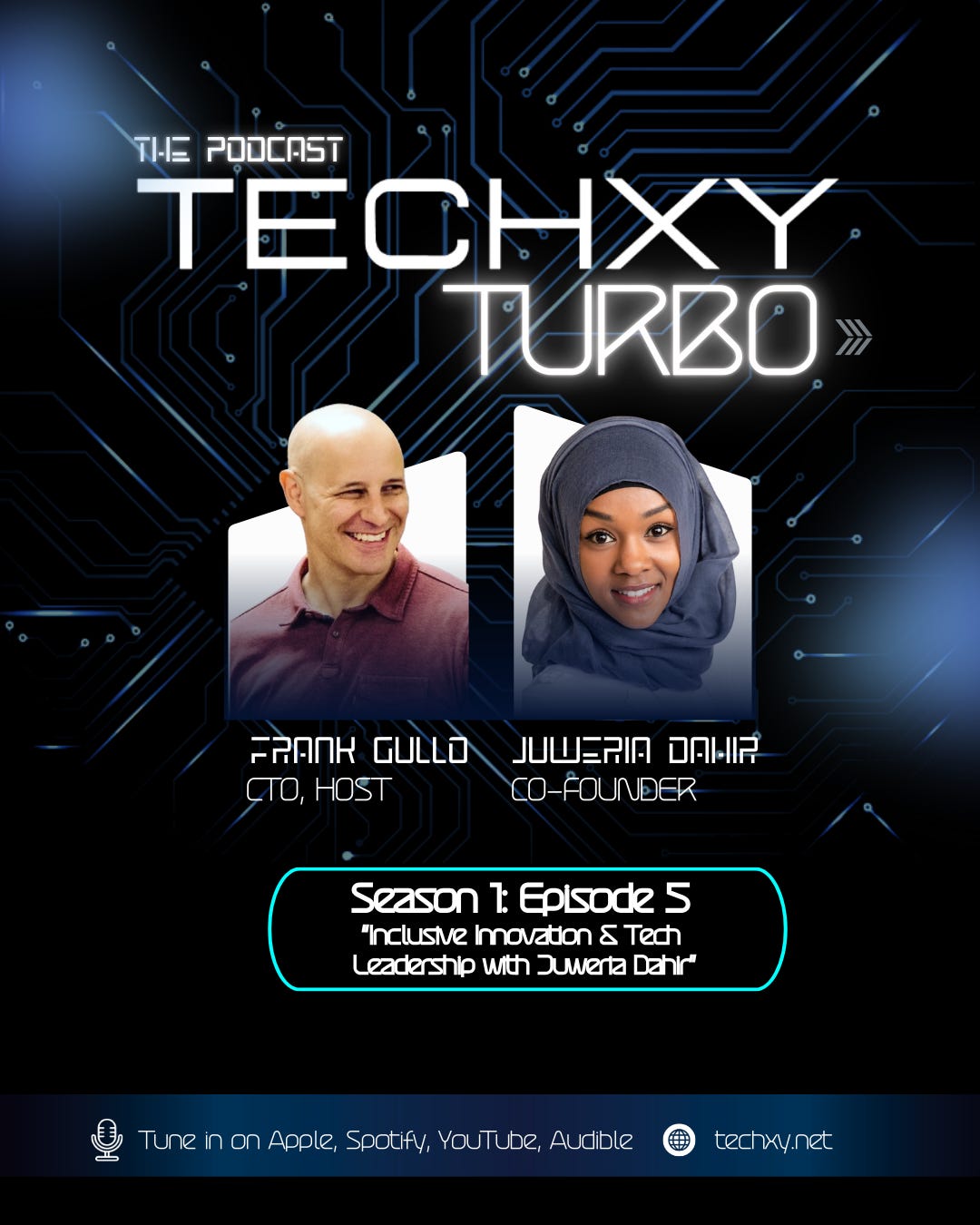
TechXY Turbo - Episode 5
Inclusive Innovation & Tech Leadership with Juweria Dahir
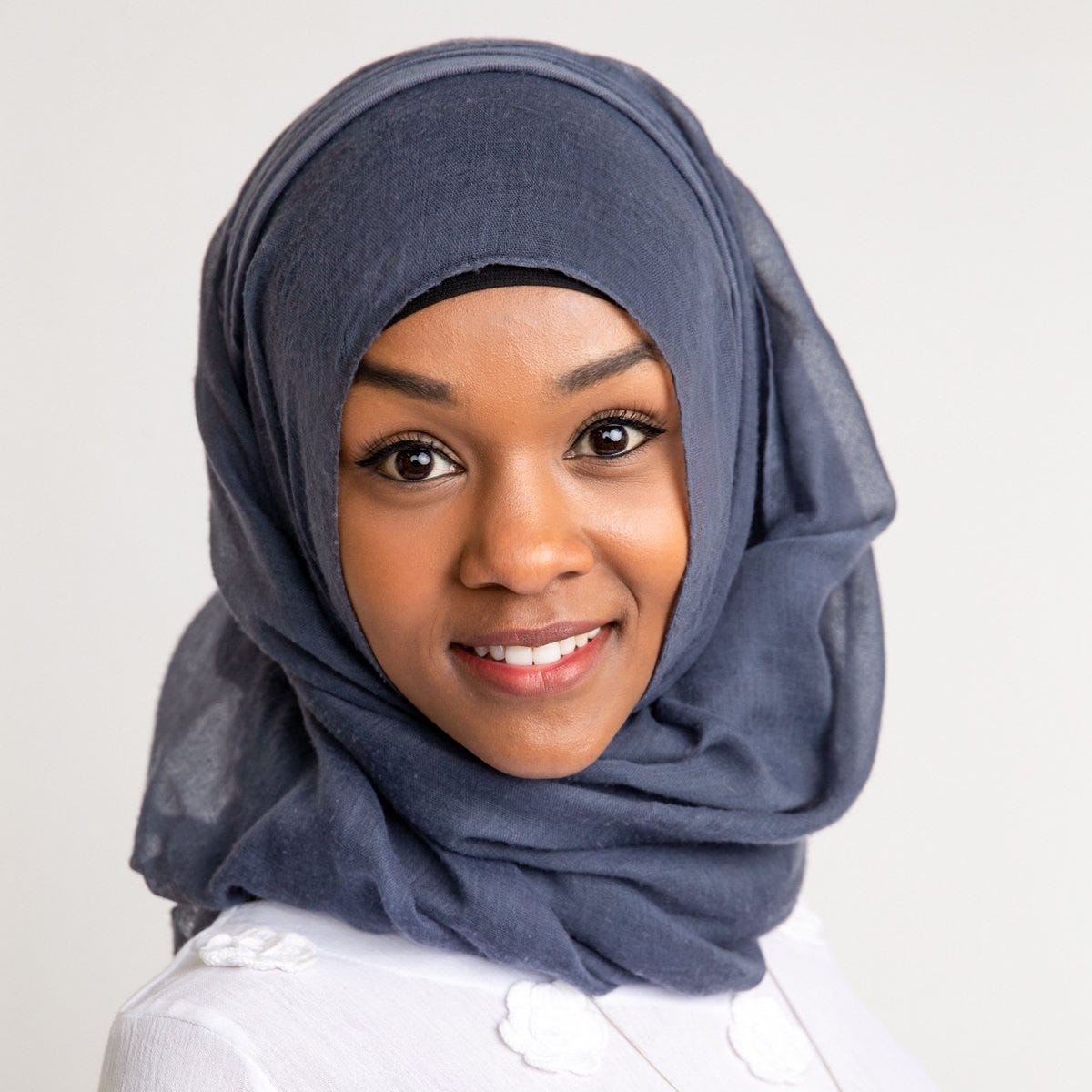
Juweria Dahir is a leader in innovation, entrepreneurship, and governance. She is the founder of JD Vertex, a data evaluation firm that helps organizations and entrepreneurs turn data into meaningful stories that demonstrate impact. She also co-founded SheConnects, a startup supporting female founders in both for-profit and non-profit sectors through resources, networking, and support.
Juweria served as the Director of Innovation and Entrepreneurship at BNMC, where she led the development of its first business accelerator for early-stage startups and continues to shape programs that support inclusive entrepreneurship and business growth. Her work builds on six years in city government as a City Planner and External Affairs Manager, where she advanced neighborhood development and economic policy.
She also teaches business and entrepreneurship as an Adjunct Professor at Daemen University and holds a Master’s degree from the School of Architecture and Planning at the University at Buffalo. Her career bridges public and private sectors with a focus on driving equitable and lasting economic impact.
Transcript
Frank Gullo: Welcome to another episode of TechXY Turbo, a tech podcast providing independent technology content and perspectives. My name is Frank Gullo and I am your host. Before we wrap up this first season of TechXY Turbo, let me tell you a little bit about this studio recording in today. ROC Vox Recording & Productionis just outside of Rochester, NY. The studio works with businesses, entrepreneurs, brand agencies, and does podcast as well as content creation for social media, radio, TV, and even some film work. As they like to say, you do the talkie stuff and they do the techie stuff. Check them out at RocVox.com.
Frank Gullo: This episode of TechXY Turbo will include my interview with Juweria Dahir, innovation leader and Community Champion. We'll talk about the evolving relationship between technology, entrepreneurship and inclusive growth. From her work at BMC to co-founding, SheConnects, Juweria Dahir sheds light on what it takes to support underrepresented founders, build equity through innovation, and stay grounded in purpose while navigating a tech driven world.
Frank Gullo: Juweria, so great to have you here on TechXY Turbo.
Juweria Dahir: Well, thank you so much.
Frank Gullo: To start, can you tell our listeners a little bit about yourself, what you do and the work you're currently involved in?
Juweria Dahir: Yeah, sure. Thank you so much for having me. I really appreciate it. Like you said, I'm here, I'm actually a Buffalo transplant. Moved to this country in 2013. I've called it home since, I'm a I'm a mom of four, and I've pretty much kind of bounced around and pivoted my entire career. But overall, I look at myself as a purpose driven leader.
Juweria Dahir: I've got a decade of experience, both in community engagement, innovation, a ton of work around organizational development, and then prior to doing the work that I currently do, I actually worked in the public sector, where I spent six years in government, leading a ton of beautification and restoration work. And then during COVID, I pivoted, decided to join the business sector. I know that's where you and I met at the Buffalo Niagara Medical Campus. And there I pretty much led all of the entrepreneurial innovation work. I helped support and lead the first business accelerator program out of the Buffalo Niagara Medical Campus. And then from there, I was really just inspired to launch two other companies.
Juweria Dahir: I've got my own data evaluation firm called JD Vertex. And then you already mentioned SheConnects which is really there to support female founders in the nonprofit and for profit world.
Frank Gullo: Really excited to ask some questions about that. But first, this is a tech podcast. How would you describe your relationship to technology generally?
Juweria Dahir: I would say it definitely evolved. I think I started viewing tech as a resource early on. And then eventually early on in my career, I looked at it as a tool, and then now it's really shifted to a mindset. And so, obviously my background being in architecture and urban planning, you know, whether it's GIS in city planning or just overall digital dashboards and community work, I really think technology, at least for me, I see it as a way to just connect the dots, for it to make sense of the systems that we're part of and then hopefully, you know, be able to scale different types of impacts.
Frank Gullo: Yeah, that bridges well into your work and your focus. As I read, your bio spans innovation, entrepreneurship and leadership. How vital would you say technology is in all of these areas?
Juweria Dahir: It really is for every single one of them. And when you think of technology as a mindset, you know, you start to look at it as a support, a way for it to actually complement your work, to make your life a little easier, maybe to to help you save time, save money. And so whether it's day to day operation or even just being a mom at home, technology is definitely something that I have to use in order to move my life forward.
Frank Gullo: As you know from the Buffalo ecosystem, lots of tech founders, lots of, technology, from your experiences advising entrepreneurs as they're building new ventures and new businesses, how do you see that tech is helping or hindering them?
Juweria Dahir: That depends. I mean, you talk to, nonprofit leaders and a lot of them are obviously just, starting out, with fundraising and trying to figure out ways to engage their donors, for example. And so it's so critical at that stage to actually have a CRM system that works, one that you can track with, one that you can actually cultivate relationships with donors, and then be able to do some back end reporting to your team so that you can see what's working and what's not.
Juweria Dahir: And so I think using technology in that sense, not only is it important to actually understand what platforms is necessary to use, at what point and what time, but also get the like minded individuals to help run and navigate these systems, because people really think of technology as a different language. And either you know the language or you don't. And what I always advise people is, you know, figure it out. Figure it out. Not alone. Figure it out with people and try not to make any expensive decisions. Try to use the very basic data Excel sheets, if necessary. You know, try to scribe it out on a piece of paper to begin with. And then at some point, put some capital behind it and build out a system that actually it works for your, for your needs.
Frank Gullo: That seems very practical and resonant with a lot of feelings of being overwhelmed that I hear from some. So for those early stage entrepreneurs who do feel overwhelmed by technology choices, what's a key piece of advice you give them about prioritizing and adopting tech to grow their business? Without breaking the bank.
Juweria Dahir: I like that question. I guess, in today's world, you know, obviously innovation is just just accelerated in many different ways, whether it's the digital platforms. And a lot of people use cloud solutions. I'm actually not familiar with all of that. But whatever data tools that they're using, technology is ultimately, the backbone of all of it.
Juweria Dahir: And so more than that, I think what it does is it allows and I don't know if people actually still use this term, but it allows people and the whole process to be democratized. By that I mean it becomes accessible. So think of, you know, small business owners, without technology, they wouldn't even be in a position to actually compete in this global market. And so for these small businesses, especially those that are led by women or people of color, I think they're able to compete and potentially thrive because of their understanding of the vitality of technology in innovation and entrepreneurship.
Frank Gullo: Right. Makes sense. Well, on that note, pivoting to your work. So say for a platform like SheConnects where you focus on resources, networking and support. How have you used technology to change the way entrepreneurial communities are sustained, especially post-pandemic? Are you finding the virtual tools as effective as in-person connections?
Juweria Dahir: Yeah. During my, during Covid, I was actually in city government, and then I transitioned to the business sector and my goodness, what a big jump. What a big, difference. Oftentimes we think government is a leading innovation. Unfortunately, it's not. And that's part of the reason why we need to have more innovators, supporting public policy and forces in government.
Juweria Dahir: In terms of She Connects and how technology is shaping this post-pandemic world, I think it's just transformed how we build relationships. Before the pandemic, I at least hadn’t spent enough time doing hybrid work. A lot of the work that I was doing was in-person, face to face interactions. And now seeing how that's shifted post-pandemic. I'm relying on tapping into Zoom and other online platforms like Slack. We've held several online events to to really make sure that we're able to reach founders across different cities, sometimes even globally. Because I'm a Buffalo transplant. I grew up in Europe. And so with the SheConnects platform having access to this online space, we were able to also tap into some of our peers, in the UK and others across the country.
Juweria Dahir: I think for me some of these connections require intentionality. So it comes down to, you know, the balance. Virtual access with in-person, but also centering on building trust. And when it's necessary, we do things virtually. But other times it's really good to be in-person. And we actually just had a fantastic event at the History Museum this past (March 2025), as part of Women's History Month, we were cementing history, and we, we had the privilege of honoring 24 incredible women.
Frank Gullo: That's great. And on that note, through SheConnects or your other work, have you observed particular tech challenges or opportunities unique to female founders? And are there specific tech resources or digital initiatives that are crucial for women that you'd support and would recommend?
Juweria Dahir: Absolutely, 100%. So first of all, English is my fourth language. And so, I don't know what where technology would fall in in that fourth language space, but, if, you know, for any woman that's similar to me, you can relate to that. I think the challenges of technology is very prominent, and it just starts with, what I call Digital Confidence.
Juweria Dahir: The feeling like they have to, as women, feeling like they have to master tech before even launching. And so there's just so much, limited access to capital for tech upgrades for women, generally speaking. And then, and that's part of the reason why we actually focus on building digital literacy and demystifying, you know, a lot of these tools during some of our SheConnects sessions. We held a financial series and all of that was accessible to women, especially women of color. It was free of charge. It was done virtually. But one of the things that came out of it was, you know, the confidence aspect of it. A lot of women are just worried that they're going to come across as, not being the right fit for that specific role.
Juweria Dahir: Being questioned as to why they're launching that business. And then the fear of failing and then you on top of that, you add technology to it. That gap itself, if you don't have the confidence to actually start something off, you're not going to be able to actually launch it, let alone grow it. So that's definitely something that I have observed.
Frank Gullo: For so many startups, as well as larger organizations, they collect data but struggle to act on it. So when we think of tech and beyond the tools, the visualization tools, what tech processes or strategies do you recommend to help ensure data, leads to tangible action and improvement and is an accelerator for founders?
Juweria Dahir: Yeah, very good question. One of the things that I always ask people is when it comes to data and visualization, because that's something I'm really passionate about. I ask them to draw, or describe, a puppy using data, and that's very difficult. It's almost impossible. How do you use numbers to actually narrate a story or describe a puppy? And so the reason why I bring up that question is, you know, data can never stand on its own. You've got to really complement it with the story behind it.
Juweria Dahir: And so some of the things that I've used are platforms. Power BI is one that I constantly access, but even think of simple tools like Canva to just really visualize some of your basic insights. You're able to upload CVS files, Excel sheets, and really do some specific analysis or also look for specific trends. And so for me, the real magic really happens when we ask, you know, what's the story behind these numbers for instance. And that's when data really moves from a report to a roadmap.
Frank Gullo: Great. And many of those tools, like Power BI, people can learn from themselves. So the barrier is as much time and sweat equity in many of these cases.
Juweria Dahir: Absolutely.
Frank Gullo: Great. So you're also an adjunct professor teaching business and entrepreneurship in this setting. How do you incorporate the rapidly evolving tech landscape? Everything from AI low-code, no code, data privacy, as well as curriculum to help students.
Juweria Dahir: Yeah. A lot of young people are not using, technology when it comes to this. I mean, for one of my classes this semester, at least six out of the 20 had never used ChatGPT. And I thought at this point, every single college level student was using ChatGPT. So just making sure that we're constantly reinforcing, and reminding, especially our students, the technology that's available is so critical. And so one of the things that we do in my classes is we explore just low code tools. A ton of digital marketing platforms. We also discuss ethical AI case studies because that's really important for me. And then I challenge overall the students to not just build some of their MVPs with accessible platforms that other small businesses that they're actually supporting the community can also use.
Juweria Dahir: But then also just consider basic, basic things that a lot of us forget, you know, consider data privacy very early on. And then it's about giving them just real world experiences. So a lot of the tools that they use, it has to be accessible to a small business owner that might be in a distressed part of the city that starting out their business, whether it's in tech, whether it's a chicken, a waffle business, a retail brick and mortar, whatever it is. I think it's just so important to make sure we're able to bridge that gap. And so the store, the, sorry, the students are supported. They're growing their technology backgrounds. But really with an entrepreneurial mindset, because the class focus is really on their mindset, making sure that they're ready to cultivate some specific characteristics that help with their mindset so that they can start taking calculated risks.
Juweria Dahir: Start looking to technology as a tool. And then hopefully shifting their mindset and not be worried about using the technology in their day to day life and also in their learning.
Frank Gullo: So your career spans public service as well as private enterprise.
Juweria Dahir: Yeah.
Frank Gullo: In your expertise, how can tech serve as a bridge between government initiatives and the needs of the startup innovation tech ecosystem?
Juweria Dahir: I think government can really use tech to be more transparent and obviously be more responsive. That's for one, open data. Particularly when it comes to budgeting platforms. Of course, the city has that data accessible. The county has that data accessible, but making sure budgeting platforms are accessible, a ton of mobile engagement tools, that's also critical, I think. Another thing that I would say is startups really need to understand how to plug into some of these systems. It's no good. It's not just being available, but having the right plug in systems. And that's where a lot of the cross-sector partnerships are just really key. And so we can't look to government to constantly just come up with solutions. We've got to be able to help figure some of that out. Like they say, cities have big problems, but they've got big solutions too. And so being able to bridge government to start up is still critical. As we move forward.
Frank Gullo: And speaking of cities, you and I both have worked in the city of Buffalo, and I'm very curious: I know you helped launch the City of Buffalo's Open Data portal, which is part of a Bloomberg Philanthropies initiative. So from this experience, where did you see the biggest gaps or opportunities for the city of Buffalo or local governments in general to adopt tech more effectively to drive neighborhood development growth?
Juweria Dahir: So first of all, you know, now it's it's all sexy. And everybody has an open data portal. Many of the cities. But when I was still in city government, the process was for the general public to put in a formal request and this is the freedom of information, and you would send out an email and you would probably land on some sort of a manager's desk.
Juweria Dahir: They would have to forward that email and it goes through a chain. And it's a lucrative process. I say lucrative because it's expensive. You can't really track some of those communications. There's an overload of communication sometimes, and, you know, you're going to end up missing some of that. And so there wasn't a way to streamline, all of this data sharing process. And so, the former mayor at the time, Mayor Byron Brown, had partnered with (former NYC) Mayor Bloomberg while he was no longer mayor. But Bloomberg is known for also being mayor of New York City. And through Bloomberg Philanthropies, there was a partnership called What Work City, and the goal there was to bring in as many cities as possible and start to teach. And I really say this teaching because it took a lot of unlearning. City departments and city leadership, the importance of opening up data. And so initially it became a big challenge because it started to unpack which data sets we should make accessible? What's the benefit? Does this now challenge or make the lives of city governments very difficult?
Juweria Dahir: And then we went to New York City. We met up with like minded, cities from Jacksonville to Rochester. And we all had the same problems. We had data. We were sitting on a ton of data. Data that ranged from 311, which is the column resolution center, all the way to data that addressed, public policy funding gaps. And so in its connectivity, when we worked to actually make the data accessible to the general public, we found so many people jumping, and nominating themselves to say, here are some solutions that we would like to share. Here's a way to mitigate some of these issues. Here are some trends that we are noticing between your data sets, whether it's related to crime and streetlights going out, data sets that we were not even correlating.
Juweria Dahir: And so it really became so important. And for me, this was such a pivotal project and experience. It helped us really shift from reactive governance. We became more proactive, in terms of our service deliveries. It also really encouraged civic tech collaboration. A lot of coders were able to start to participate in city related events that I had never seen before. Urban planners, community groups that were using data to solve problems together.
Juweria Dahir: I'll tell one funny story. When we launched the open data portal, the mayor wanted to make sure that everybody had access to use the platform. And so we put out a curriculum, a four week, call it an accelerator. And we actually had an 80 year old woman participate in the open platform class.
Juweria Dahir: And she was able to visualize data sets. She had grandchildren, great grandkids. And she wanted to better understand how, in terms of supply and demand, what was available in Europe for childcare. And she was able to figure out funding because she saw that her district was being ticketed quite a lot. And so she tried to pull some of those resources and say, here's how we can use the funding from driver fees to actually fund daycare centers and childcare.
Juweria Dahir: And it was a fantastic. But she was 80 years old. So if you set up the platform, the key is make it accessible and make sure you spend time and resources in that.
Frank Gullo: That's a great story from your work. Do you feel there's more that cities can do right now and should do more tech? Like for me this is silly, but sometimes I'm sitting at traffic lights and it's all red. There's no cars, so I wonder more why don't we have AI sensors everywhere? But I'm curious: in your experience, what do you think is available right now that could be used?
Juweria Dahir: Yeah, sure. I think, you know, where local government generally where they can adapt, I guess. I think it still in permitting some of these accesses. When it comes to grants, there's really a lot of limitation when it comes to grant and funding. And I say that because a lot of nonprofits and organizations rely heavily on those resources. Resident services: I think a lot of that information should be accessible. Maybe streamlining can actually open doors for small businesses and make cities a little bit more equitable because, again, a lot of small businesses are operating in silos and they're isolated. And so I'd love to see, you know, in the next five, ten plus years, I'd love to see more investment in the digital literacy for the public.
Juweria Dahir: I think we started to talk about that a little bit during Covid, mentioning the digital divide. But now that Covid is almost in the past century, it's as if that, division is not as important. So I'd love for that conversation to still be at the forefront for everybody.
Frank Gullo: Great. So looking ahead, what emerging tech trends — everything from AI and machine learning to advanced analytics — do you believe will most significantly change how orgs and cities measure and communicate their social and economic impact?
Juweria Dahir: Well, for me personally, I mean, I use platforms like WhatsApp, and I've noticed for my friends that don't have any international friends or peers, they're not familiar with WhatsApp. And so WhatsApp is obviously a big platform for many, users when it comes to emerging technologies. And I think there will be future spinoffs, but I think, AI and other predictive analysis, you know, analytics are definitely big.
Juweria Dahir: Maybe bigger in the US compared to the rest of the world. But Europe is definitely catching on. But I think for me, what I see is, you know, they really help us, to anticipate specific trends that we might not have been aware of. We're able to really personalize a lot of outreach because if it's not personalized, people really tend to not engage. We're able to also measure long term outcomes. So I think about all the things that is happening right now, whether it's AI or communication, understanding those long term complications and outputs are so critical. I also think I also just think really mixed media. When you think about a ton of these interactive, dashboards, when it comes to short form videos, the shorts on YouTube and Instagram.
Juweria Dahir: I think a lot of that will just really become core to nonprofits as not small business storytelling. So that's definitely something that I see people monetizing off and spending more resources on, for sure.
Frank Gullo: There's growing concern around AI being used for misinformation, surveillance and control. And your experience, do you think there's still room for techno optimism with all that's happening today?
Juweria Dahir: In short, yes. And I would say yes, but with conditions. And the reason for that is, in anything that we do, especially with tech, I think we just have to lead with values. Tech isn't always neutral. It probably never is. Actually, tech is definitely not neutral. And so I think we need diverse creators. I think we need to be more purposeful about inclusive design. And we definitely need guardrails around privacy and misinformation because we know what can happen with that. And so if we get that right, you know, that critical piece, if we really get that right. I think technology can definitely be a force for good.
Juweria Dahir: But if we don't center values, and lead with trust to begin with, I think we're going to see unfortunately, a lot of negative things come out of that. And particularly a lot of that is just misinformation.
Frank Gullo: So I've really enjoyed this conversation. Do you have any final thoughts for our listeners?
Juweria Dahir: Yeah, sure. You know, thanks for inviting me and I hope everybody continues to tune in. I'm sure there's so many new things to learn, but something that I have always been told by my mentors is, you know, don't be afraid of the unknown. Whether it's tech, whether it's data, if it's entrepreneurship, an idea, I definitely say, you know, you don't need to have all the answers just yet. You know, just stay curious, you know? Start small. Ask for help. Because progress definitely beats perfection.
Frank Gullo: Great. And then in closing, where can people connect with you? Read more about your work. Learn about your platforms.
Juweria Dahir: I've helped and coached over 200 businesses and they're all in my portfolio. The best place to contact me right now is LinkedIn. You can always, of course, email me. I'm also on different social media platforms, whether it's Facebook or Instagram. I'm excited to continue growing myself both personally and professionally. And so if you've got a question, let's ask those questions together and figure things out.
Frank Gullo: Great. Thank you very much for a wonderful conversation.
Juweria Dahir: Thanks, Frank